Hsin-Yi LinLucy

Mathematician and Research Scientist at Brookhaven National Laboratory. I started with transport equations and now design quantum machine learning models, using the same mathematics throughout.

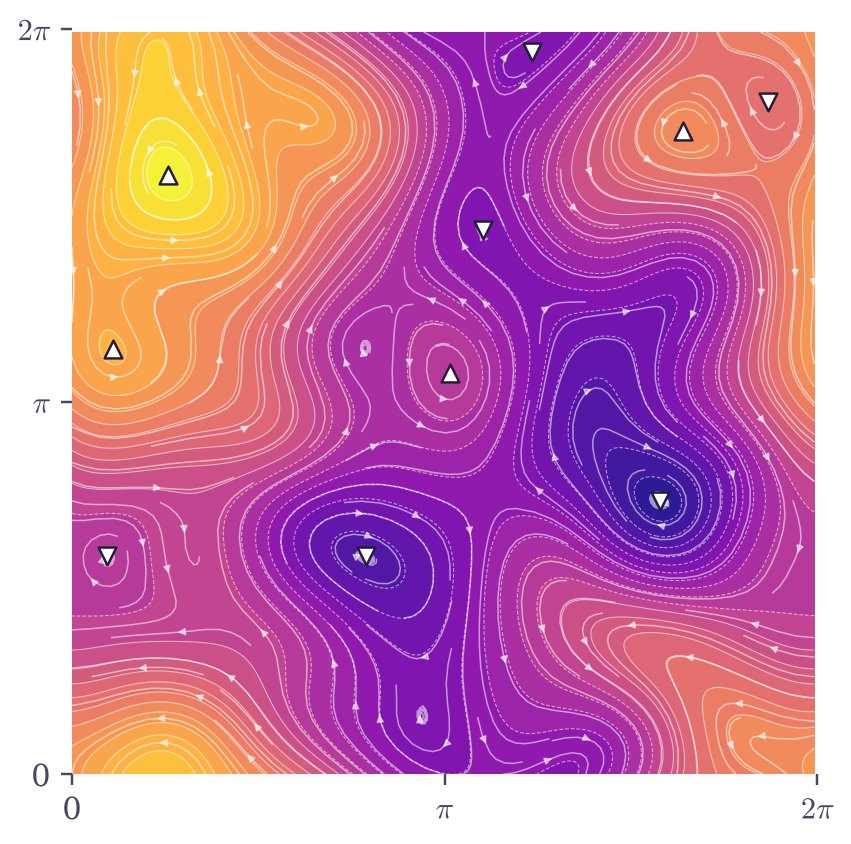
Live figure. Tracers carried by the incompressible flow \(a=\nabla^{\perp}\psi\) on the torus \(\mathbb{T}^2\), where \(\psi\) is a random Fourier series. Fluid circling a local maximum or minimum of \(\psi\) can never mix with the rest: the unmixing result in Chapter 3 of my thesis.

About

I am a Research Scientist in Computing & Data Sciences at Brookhaven National Laboratory, working on quantum computing and quantum machine learning. My training is in analysis: my Ph.D. at the University of Maryland, with Pierre-Emmanuel Jabin, was on dispersion and averaging in transport equations, mixing of incompressible flows, and memory-driven models of animal migration.

Since then I have carried the same tools into machine learning (optimal transport for speech, variational analysis of deep networks, neural forecasting of chaotic geophysical systems) and into quantum computing, where I treat the measurement of a quantum circuit as something to be learned rather than fixed.

Before Brookhaven I was an Assistant Professor of Mathematics and Computer Science at Seton Hall University, a postdoctoral researcher at the University of Colorado Boulder, Academia Sinica and the University of Montana, and a data scientist at Bank of America. I review for ICML, ICLR and IEEE journals and conferences.

  • NowResearch Scientist, Brookhaven National Laboratory
  • Ph.D.Mathematics, University of Maryland, College Park, 2020
  • M.S., B.S.Mathematics; Physics & Mathematics, National Tsing Hua University
  • ToolsPyTorch, PennyLane, Qiskit, CUDA/CuPy, HPC clusters
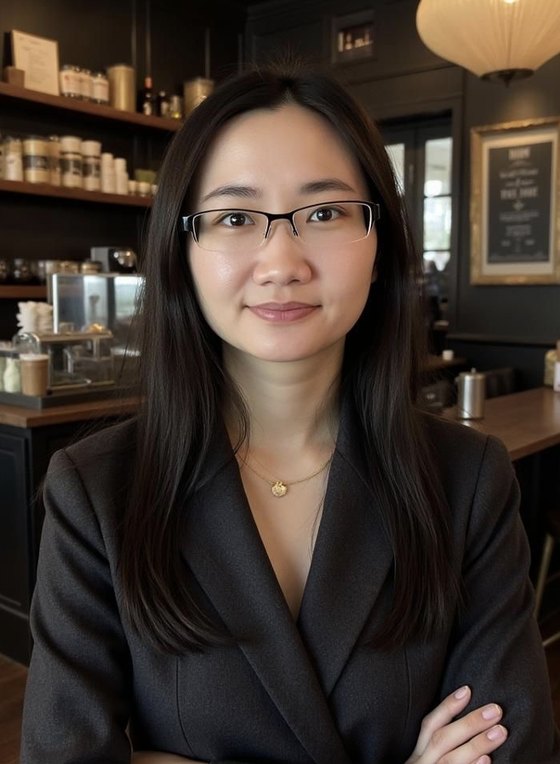
Portrait of Hsin-Yi (Lucy) Lin
Upton, New York

One thread, five chapters

Each project below asks how something is carried: a density along velocities, fluid along streamlines, an animal along what it remembers, probability mass from noisy to clean data, and a quantum observable along a unitary path. The chapters run in the order I worked on them.

§1

Averaging lemmas for kinetic transport

Ph.D. thesis, Chapter 2; with P.-E. Jabin and E. Tadmor

A density \(f(t,x,v)\) of particles at position \(x\) with velocity \(v\) can be as rough as its data. Its velocity averages are better behaved: they gain fractional derivatives in \(x\). These averaging lemmas are a key source of compactness in kinetic theory and of regularity for conservation laws.

$$\partial_t f + a(v)\cdot\nabla_x f = (-\Delta_v)^{\kappa/2} g$$ $$\rho_\varphi(t,x)=\int f(t,x,v)\,\varphi(v)\,dv \;\in\; L^2\big([0,T],H^{s}_{x,\mathrm{loc}}\big)$$

Given \(f\in L^\infty_tL^{p_1}_xL^{p_2}_v\), \(g\in L^1_tL^{q_1}_xL^{q_2}_v\) and a non-degenerate \(a\in \mathrm{Lip}\), the average lies in \(H^s\) for every \(s\) below an explicit exponent \(S(p_i,q_i,\kappa,\gamma)\).

We introduced a commutator method: pick a multiplier \(Q\) so that its commutator \([B,Q]\) with the transport operator \(B=a(v)\cdot\nabla_x\) is positive and gains a derivative, the mechanism behind local smoothing for dispersive equations. The proof needs only elementary Fourier analysis, covers a new range of integrability assumptions, and gives a direct regularity result for measure-valued solutions of scalar conservation laws in one space dimension.

Analysis & PDE 15 (2022), arXiv:2003.05047, Séminaire Laurent Schwartz (2021)
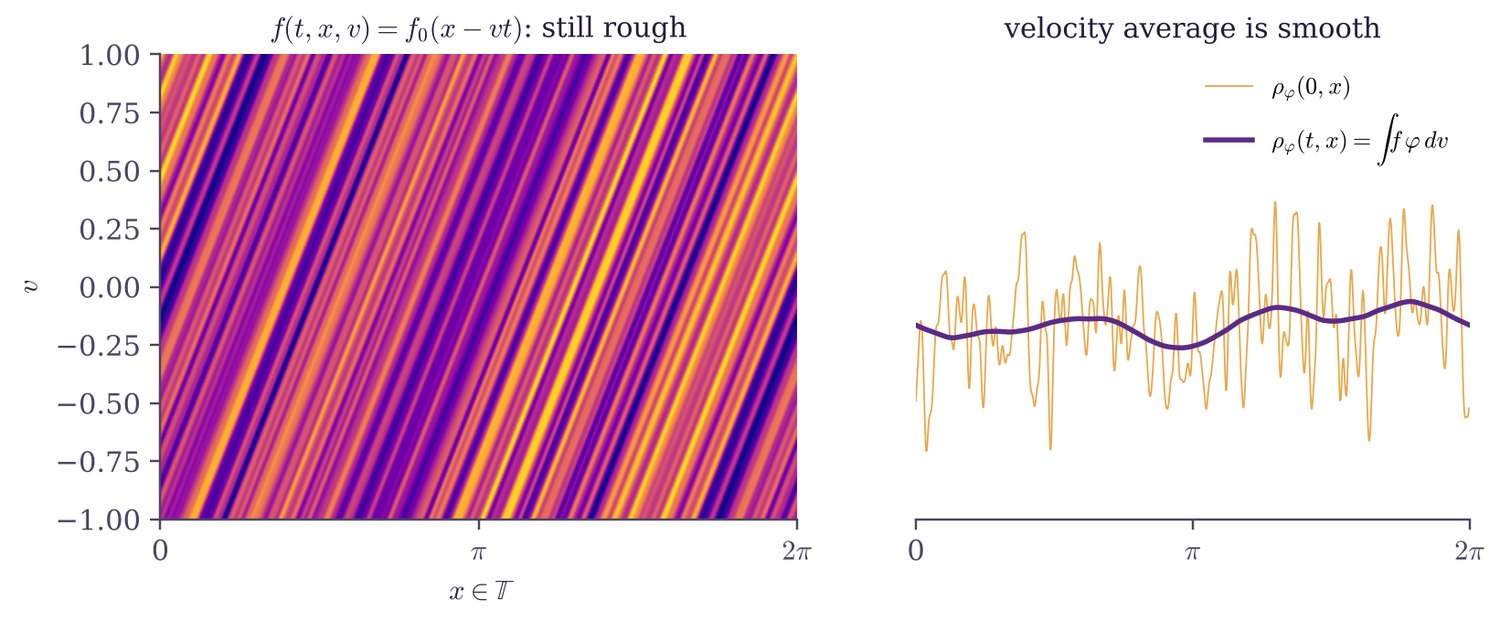
Left: a striped, rough density in the x–v plane. Right: a jagged amber curve and a smooth violet curve showing the velocity average.
illustrationAveraging smooths. Under free transport each slice \(f(t,\cdot,v)=f_0(\cdot-vt)\) stays as rough as \(f_0\), yet \(\rho_\varphi(t)=f_0*\varphi_t\) is smooth for \(t>0\).
§2

When incompressible flows cannot mix

Ph.D. thesis, Chapter 3

A divergence-free field on the two-torus is the rotated gradient of a stream function, and the transport equation \(\partial_t f+\operatorname{div}(af)=0\) inherits a Hamiltonian structure: \(\psi\) is constant along every trajectory.

$$a=\nabla^{\perp}\psi=(\partial_2\psi,\,-\partial_1\psi),\qquad \frac{d}{dt}\int_{\mathbb{T}^2}\Phi\big(\psi(x)\big)\,f(t,x)\,dx=0 .$$

Using this, I showed that a flow is unmixing whenever \(\psi\) has a local maximum or minimum, and that the property survives any perturbation of \(\psi\) that is small in sup norm. Taking \(a\) to be a random Fourier series turns this into a quantitative, probabilistic statement about when mixing fails, read off from Fourier coefficients.

Thesis: Dispersion Properties of Transport Equations and Applications, University of Maryland, 2020.

Colored map of a stream function on the torus with white streamlines circling its peaks and valleys, marked with triangles.
illustrationIslands that never mix. Level sets of a random \(\psi\) on \(\mathbb{T}^2\) with streamlines of \(\nabla^\perp\psi\). Local maxima (▲) and minima (▼) trap the fluid around them.
§3

Memory and migration

Ph.D. thesis, Chapter 4; with W. F. Fagan and P.-E. Jabin

Animals return to places they remember. I modeled each memory channel as a field \(M_i(t,x)\) that fades nonlinearly, reaching zero in finite time, and is refreshed by what the animal perceives through a kernel \(K\) centered at its position \(X(t)\). The animal then moves by optimal control: a Hamilton–Jacobi–Bellman value function built from how it evaluates each location.

$$\partial_t M_i=\kappa_i\Big[-d_i\,\operatorname{sgn}(M_i)\sqrt{|M_i|}+u_i\,K\big(X(t),x\big)\big(E(t,x)-M_i\big)\Big]$$ $$H(t,x)=\sum_i w_i\,M_i(t,x)$$

\(E\): environment quality, \(d_i,u_i\): decay and update rates, \(w_i\): weights that combine the channels into the evaluation \(H\).

Simulations in a periodic two-habitat environment show what memory must provide: periodic migration needs both short-term and long-term memory, with time scales in the right order and the ability to weigh one against the other. At the University of Montana I applied the same modeling habits to Chronic Wasting Disease, combining contact-network structure with stochastic models and data-driven inference.

Journal of Theoretical Biology 508 (2021)

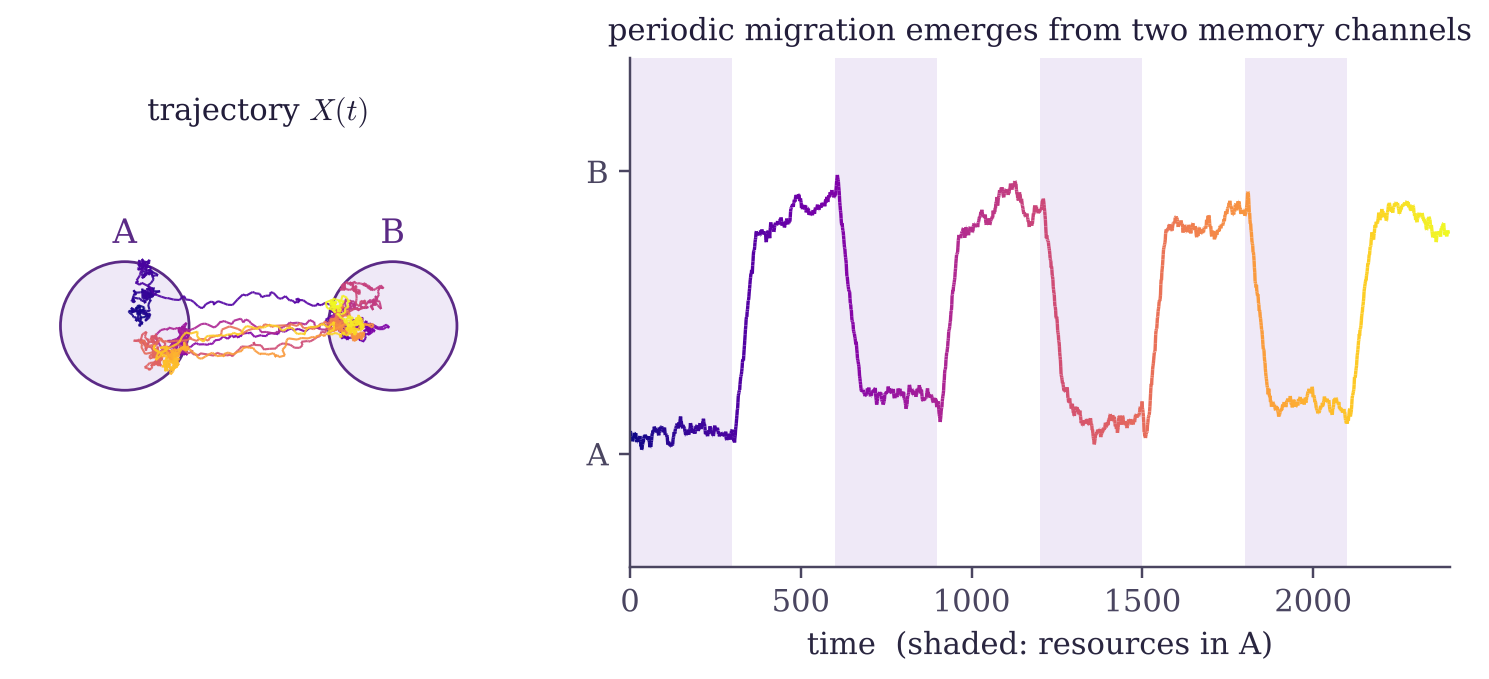
Left: a path shuttling between two circular habitats A and B. Right: position over time switching between A and B in step with the shaded resource periods.
re-simulationFollowing resources. The two-channel memory model in an environment whose good habitat alternates between A and B. Color is time. Movement is simplified to steering toward \(\arg\max H\).
§4

Learning with transport, variations and dynamics

2020–2025: CU Boulder, Academia Sinica, Bank of America, Seton Hall

In machine learning I keep reaching for analysis. For speech enhancement without clean labels, I moved noisy feature distributions onto clean ones with discriminator-constrained optimal transport (NeurIPS 2021). To explain domain adaptation, a layer variational analysis treats fine-tuning as a variational problem across layers (ICLR 2023). Stochastic neighbor embedding with an α-divergence decomposes into attractive and repulsive forces (IEEE Access 2024).

$$\min_{T:\;T_{\#}\mu=\nu}\;\int c\big(x,T(x)\big)\,d\mu(x)$$

Monge's problem: the cheapest way to push the distribution \(\mu\) onto \(\nu\).

For chaotic geophysical systems I combined recurrent networks with data assimilation for scalable state estimation and forecasting (JAMES 2022) and developed Fourier reservoir computing for multi-scale quasi-geostrophic dynamics. Recent work covers retrieval-augmented prompt learning against LLM hallucination (IEEE/ACM TASLP), contrastive diffusion models, and multi-channel speech enhancement.

NeurIPS 2021, ICLR 2023, IEEE Access 2024, JAMES 2022, TASLP

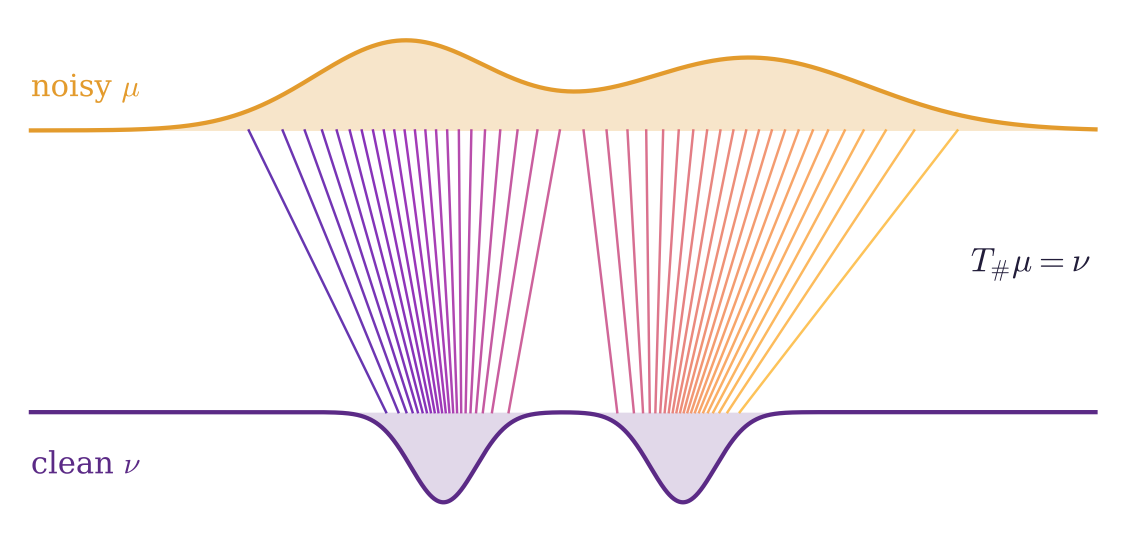
Two density curves joined by colored lines that map quantiles of the noisy distribution onto the clean one.
illustrationTransporting distributions. The monotone (Brenier) map pushing a broad, noisy feature distribution \(\mu\) onto a sharp, clean one \(\nu\).
§5

Learnable measurements for quantum neural networks

2024–present: Brookhaven National Laboratory and collaborators

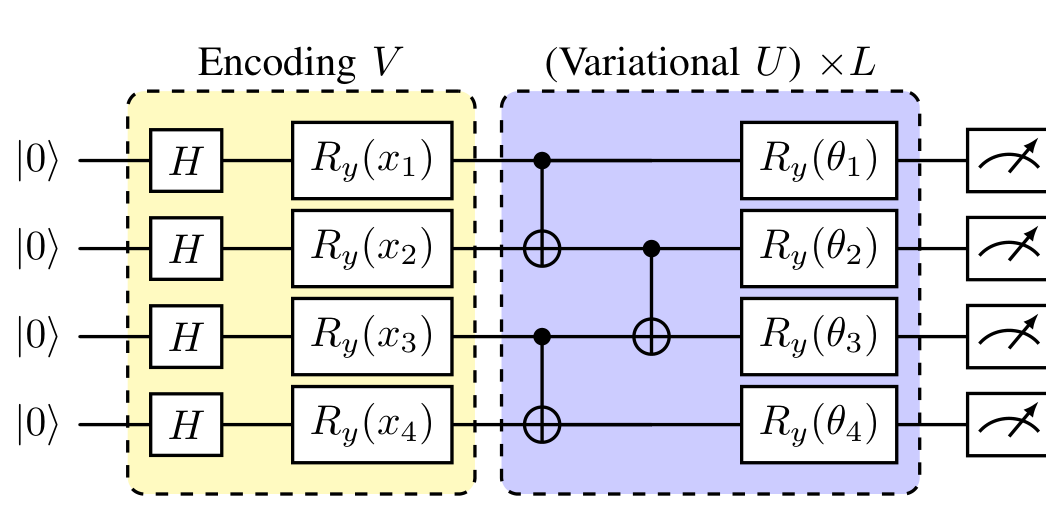
A variational quantum circuit (VQC) encodes data, applies a trainable unitary \(U(\theta)\), and measures a fixed observable, usually a Pauli \(Z\). In the Heisenberg picture the observable moves instead of the state, so training traces a path \(H(\theta)=U^\dagger(\theta)H_0U(\theta)\) in the space \(\mathbb{H}(n)\) of Hermitian matrices. Why not let the measurement learn too?

$$f_{\theta,\phi}(x)=\big\langle\psi_x\big|\,U^\dagger(\theta)\,\widetilde H(\phi)\,U(\theta)\,\big|\psi_x\big\rangle,\qquad \widetilde H(\phi)\in\mathbb{H}(k),\;k\le n$$

\(\widetilde H(\phi)\) is a trainable \(k\)-local Hermitian observable with \(4^k\) real parameters. A fixed observable is the special case, so VQC \(\subsetneq\) ANO.

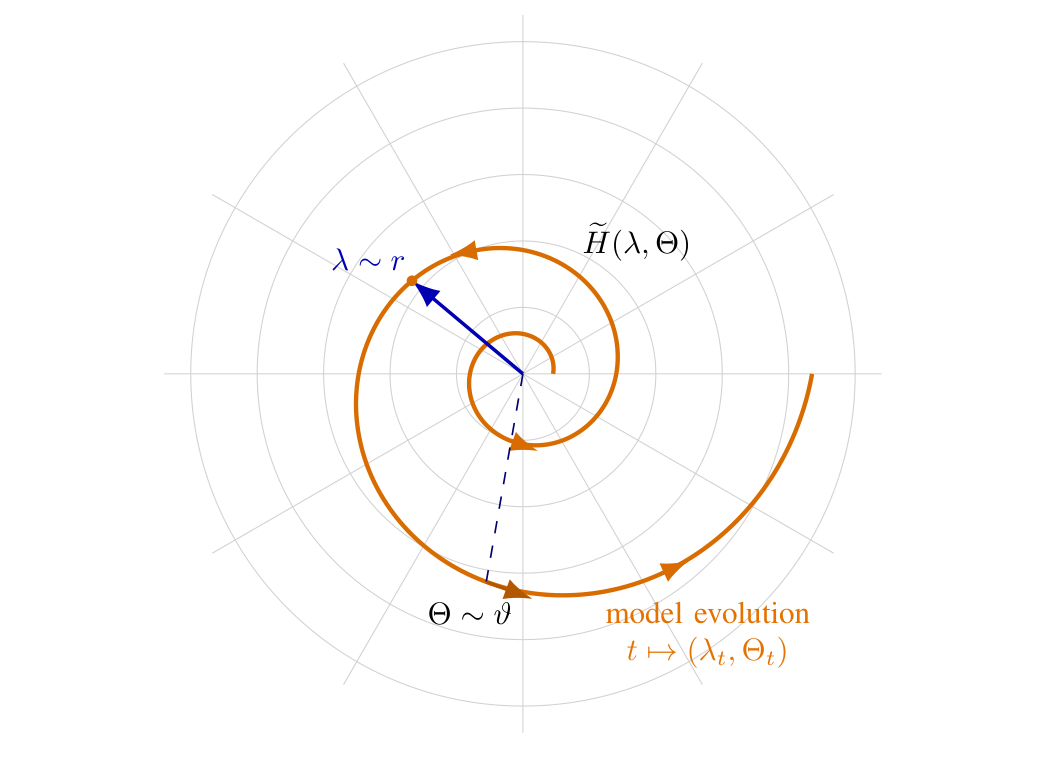
Adaptive non-local observables (ANO) enlarge the functions a circuit can represent without adding depth. Diagonal ANO keeps that flexibility with far fewer parameters. A quasi-polar decomposition splits a trained model into a radial part (spectrum) and an angular part (Lie algebra), so its training trajectory can be read geometrically. Observable geometry uses unitary orbits, stabilizers and homogeneous spaces to count a circuit's effective degrees of freedom.

Applications so far: quantum reinforcement learning, quantum super-resolution, transfer learning of VQCs, learned measurement programs, and the Quantum Gradient Class Activation Map for interpreting hybrid models.

ANO, QCE 2025, QRL, QCE 2025, ICASSP 2026, DANO, Quasi-polar, Observable geometry

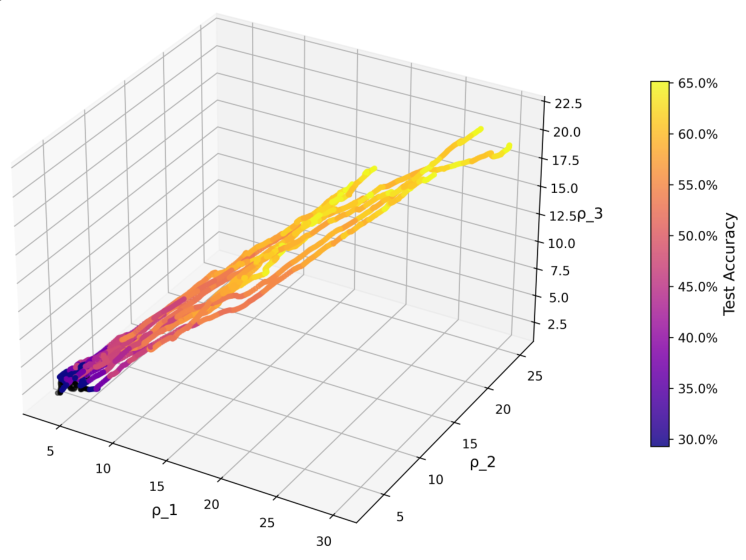
3D scatter of training trajectories rising from dark purple to bright yellow as test accuracy improves.
from the paperTraining as motion. Radial trajectories \(\rho_{t,q}=\mathrm{top}_3(\lambda_{t,q})\in\mathbb{R}^3\) of quasi-polar DANO models on Yale B, colored by test accuracy. Ho, Li, Tseng, Lin, Chen & Yoo, QCE 2026
Quantum circuit diagram: Hadamard and Ry encoding gates, CNOT entanglers and Ry variational gates, then measurements on four qubits.
from the paperThe circuit. Encoding \(V\) and \(L\) variational layers \(U\). The measurement at the right end is what ANO makes trainable. DANO, ICCCN 2026
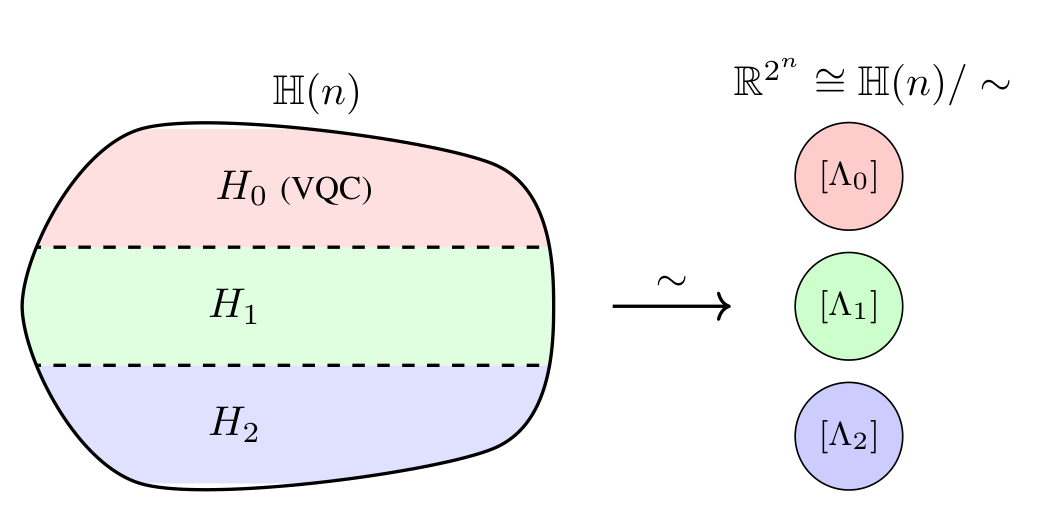
Diagram: the space of Hermitian matrices split into bands H0, H1, H2, mapped to spectral classes Lambda0, Lambda1, Lambda2.
from the paperObservables up to rotation. \(\mathbb{H}(n)\) splits into unitary-equivalence classes labeled by spectra in \(\mathbb{R}^{2^n}\), so a diagonal observable plus a unitary reaches every class. DANO
Polar diagram with an orange spiral labelled model evolution, radius lambda and angle Theta.
from the paperQuasi-polar coordinates. A model \(\widetilde H(\lambda,\Theta)\) evolves with radius \(\lambda\sim r\) (spectrum) and angle \(\Theta\sim\vartheta\) (Lie algebra). QCE 2026
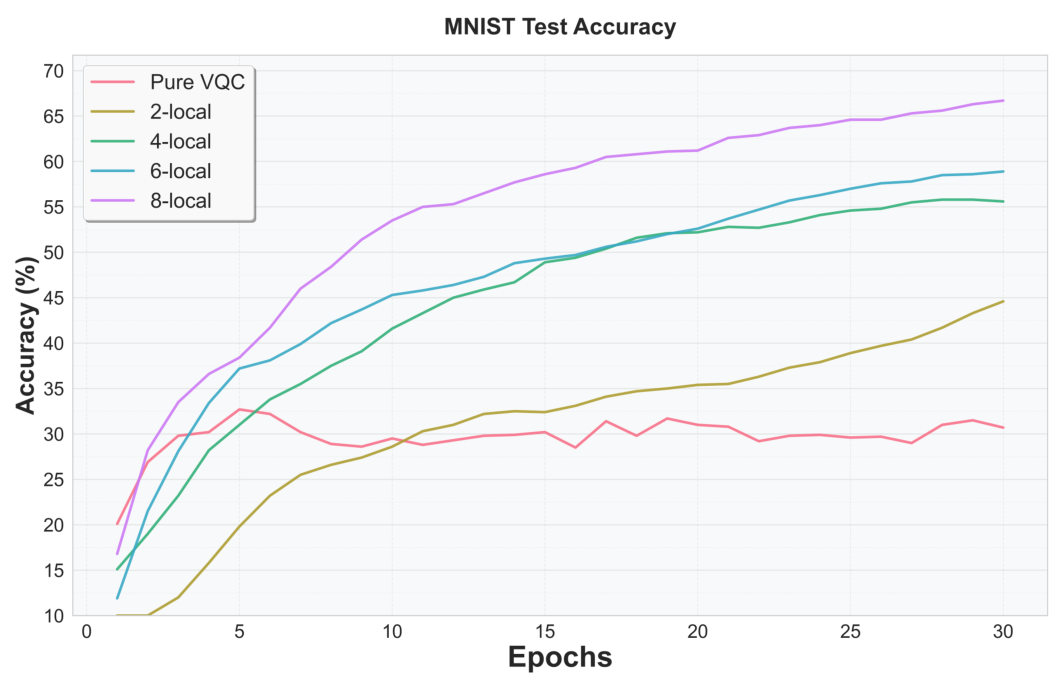
Line chart of MNIST test accuracy over 30 epochs; 8-local measurements climb highest while the pure VQC stays near 30 percent.
from the paperMeasurement locality pays. MNIST test accuracy with the same circuit: widening the measured block from 2 to 8 qubits lifts accuracy well above the fixed-observable VQC. DANO

Connections between fields

A small dictionary of the ideas I reuse. Each row is one mathematical idea, and each column shows where it appears in my work in that field.

IdeaAnalysis & PDEModelingMachine learningQuantum computing
Transportmoving mass along a field kinetic equation \(\partial_tf+a(v)\cdot\nabla_xf\) animal paths \(X(t)\) driven by remembered value optimal transport \(T_\#\mu=\nu\) for speech observables carried along \(U^\dagger H U\)
Commutatorswhat fails to commute, and what it buys \([B,Q]\) with a multiplier gains regularity — — Heisenberg evolution and the Lie algebra \(\mathfrak{u}(N)\)
Fourier analysisfrequencies and multipliers dispersion; random Fourier stream functions multi-scale quasi-geostrophic flows Fourier reservoir computing Pauli families as a basis of observables
Variational principlesoptimize over paths or functions — optimal control, Hamilton–Jacobi–Bellman layer variational analysis; variational dehallucination variational quantum circuits and eigensolvers
Geometry & symmetrywhat is invariant, what moves level sets of \(\psi\) conserved by the flow — attraction–repulsion forces in neighbor embedding unitary orbits, stabilizers, polar decomposition
Dynamics & memorystates that carry the past Hamiltonian structure of 2D flows short- and long-term memory channels RNNs with data assimilation for chaotic systems training trajectories \((\lambda_t,\Theta_t)\) of QNNs
Probability & divergencescomparing distributions measure-valued solutions of conservation laws stochastic movement and epidemic spread α-divergence SNE; contrastive diffusion expectation values \(\langle\psi|H|\psi\rangle\) as model outputs

Publications

QuantumMachine learning & AIAnalysis & PDEModeling

23 of 23
  1. 2026
    Observable Geometry for Effective Quantum CircuitsH.-H. Tseng, H.-Y. Lin, S. Y.-C. Chen, Y. M. Chan, T.-C. Wei, S. YooIEEE QCE 2026arXiv
  2. 2026
    Quasi-polar Decomposition of Quantum Neural Networks via Adaptive Non-local ObservablesS.-H. Ho, Y. Li, H.-H. Tseng, H.-Y. Lin, S. Y.-C. Chen, S. YooIEEE QCE 2026arXiv
  3. 2026
    Quantum Super-resolution by Adaptive Non-local ObservablesH.-Y. Lin, H.-H. Tseng, S. Y.-C. Chen, S. YooIEEE ICASSP 2026arXiv
  4. 2026
    Diagonal Adaptive Non-local Observables on Quantum Neural NetworksH.-H. Tseng, Y. Li, H.-Y. Lin, S. Y.-C. ChenICCCN 2026arXiv
  5. 2026
    Variational Dehallucination via Retrieval-Augmented Prompt LearningH.-Y. Lin, Y.-C. Chang, J.-T. ChienIEEE/ACM Transactions on Audio, Speech and Language Processing 34, 259–271DOI
  6. 2025
    Quantum Reinforcement Learning by Adaptive Non-local ObservablesH.-Y. Lin, H.-H. Tseng, S. Y.-C. Chen, S. YooIEEE QCE 2025DOIarXiv
  7. 2025
    Adaptive Non-local Observable on Quantum Neural NetworksH.-Y. Lin, H.-H. Tseng, S. Y.-C. Chen, S. YooIEEE QCE 2025DOIarXiv
  8. 2025
    Learning to Program Quantum Measurements for Machine LearningS. Y.-C. Chen, H.-H. Tseng, H.-Y. Lin, S. YooIEEE QCE 2025arXiv
  9. 2025
    CGDD: Contrastive Gaussian-Dirac Diffusion ModelC.-C. Chen, H.-Y. Lin, J.-T. ChienIEEE ICASSP 2025
  10. 2025
    Transfer Learning Analysis of Variational Quantum CircuitsH.-H. Tseng, H.-Y. Lin, S. Y.-C. Chen, S. YooIEEE ICASSP 2025arXiv
  11. 2025
    Learning to Measure Quantum Neural NetworksS. Y.-C. Chen, H.-H. Tseng, H.-Y. Lin, S. YooIEEE ICASSP 2025arXiv
  12. 2025
    Linguistic Knowledge Transfer Learning for Speech EnhancementK.-H. Hung, X. Lu, S.-W. Fu, H.-H. Tseng, H.-Y. Lin, C.-W. Lin, Y. TsaoarXiv preprintarXiv
  13. 2024
    MC-SEMamba: A Simple Multi-channel Extension of SEMambaW.-Y. Ting, W. Ren, R. Chao, H.-Y. Lin, Y. Tsao, F.-G. ZengarXiv preprintarXiv
  14. 2024
    Quantum Gradient Class Activation Map for Model InterpretabilityH.-Y. Lin, H.-H. Tseng, S. Y.-C. Chen, S. YooIEEE SiPS 2024DOIarXiv
  15. 2024
    On the Attractive and Repulsive Forces of Generalized Stochastic Neighbor Embedding with Alpha-DivergenceH.-Y. Lin, H.-H. Tseng, J.-T. ChienIEEE Access 12, 90380–90394DOI
  16. 2023
    On the Robustness of Non-intrusive Speech Quality Model by Adversarial ExamplesH.-Y. Lin, H.-H. Tseng, Y. TsaoIEEE ICASSP 2023arXivDemo
  17. 2023
    Interpretations of Domain Adaptations via Layer Variational AnalysisH.-H. Tseng, H.-Y. Lin, K.-H. Hung, Y. TsaoICLR 2023arXiv
  18. 2022
    Integrating Recurrent Neural Networks with Data Assimilation for Scalable Data-driven State EstimationS. G. Penny, T. A. Smith, J. A. Platt, T.-C. Chen, H.-Y. Lin, M. Goodliff, L. Fuller, H. D. I. AbarbanelJournal of Advances in Modeling Earth Systems 14DOIarXiv
  19. 2022
    Commutator Method for Averaging LemmasP.-E. Jabin, H.-Y. Lin, E. TadmorAnalysis & PDE 15(6), 1561–1584DOIarXiv
  20. 2021
    Unsupervised Noise Adaptive Speech Enhancement by Discriminator-Constrained Optimal TransportH.-Y. Lin, H.-H. Tseng, X. Lu, Y. TsaoNeurIPS 2021PaperarXiv
  21. 2021
    Fourier Reservoir Computing for Data-Driven Prediction of Multi-Scale Coupled Quasi-Geostrophic DynamicsH.-Y. Lin, S. G. PennyESS Open Archive
  22. 2021
    A New Commutator Method for Averaging LemmasP.-E. Jabin, H.-Y. Lin, E. TadmorSéminaire Laurent Schwartz — EDP et applicationsDOI
  23. 2021
    Memory-driven Movement Model for Periodic MigrationsH.-Y. Lin, W. F. Fagan, P.-E. JabinJournal of Theoretical Biology 508, 110486DOI

Ph.D. thesis: Dispersion Properties of Transport Equations and Applications, University of Maryland, College Park, 2020. Advisor: Pierre-Emmanuel Jabin.

Experience

  1. 2026 – presentResearch Scientist, Brookhaven National Laboratory, Computing & Data Sciences

    Quantum computing and quantum machine learning; collaborations on applications of quantum algorithms and the search for quantum advantage.

  2. 2023 – 2025Assistant Professor, Seton Hall University, Mathematics & Computer Science

    Led projects on foundation models, agentic AI and quantum–classical hybrid models with a focus on trustworthy, interpretable AI; GPU-accelerated and batched quantum simulation; mentored undergraduate, graduate and postdoctoral researchers; built ML and QML curriculum.

  3. 2023Postdoctoral Researcher, University of Montana

    Social-network-informed models of Chronic Wasting Disease spread, combining stochastic modeling with data-driven inference.

  4. 2022Postdoctoral Researcher, Academia Sinica, Research Center for IT Innovation

    Optimal-transport and adversarial methods for speech enhancement and domain adaptation.

  5. 2021 – 2022Data Scientist, Bank of America

    NLP and OCR pipelines with automated model monitoring under governance standards.

  6. 2020 – 2021Postdoctoral Researcher, University of Colorado Boulder

    Scalable RNN, Transformer and TCN forecasting of chaotic geophysical systems; recurrent networks with data assimilation.

  7. 2014 – 2020Ph.D. in Mathematics, University of Maryland, College Park

    Thesis on transport equations: averaging lemmas, unmixing flows on the torus, and memory-driven migration.

  8. 2007 – 2013M.S. in Mathematics; B.S. in Physics & Mathematics, National Tsing Hua University, Taiwan